
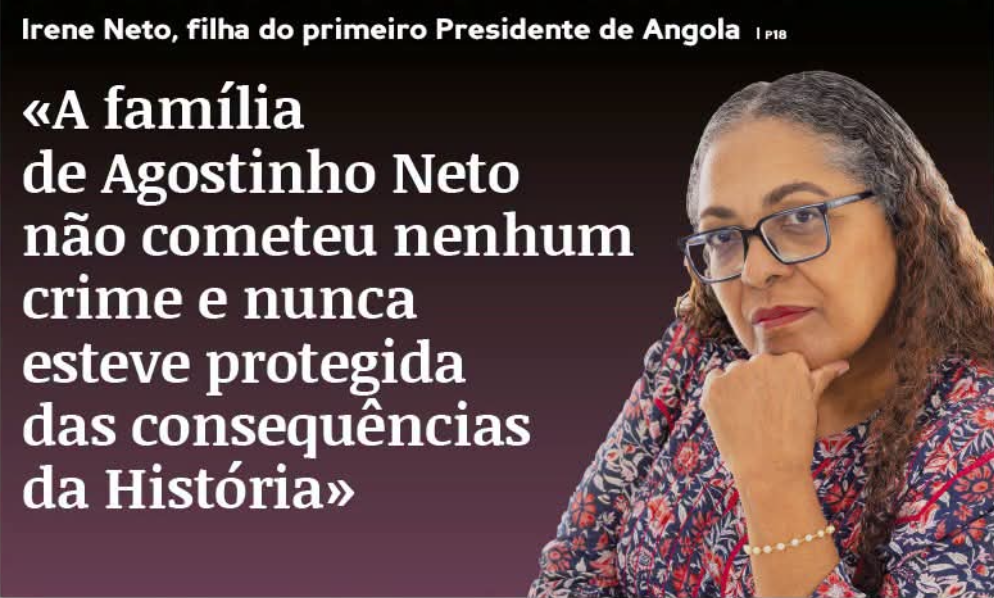
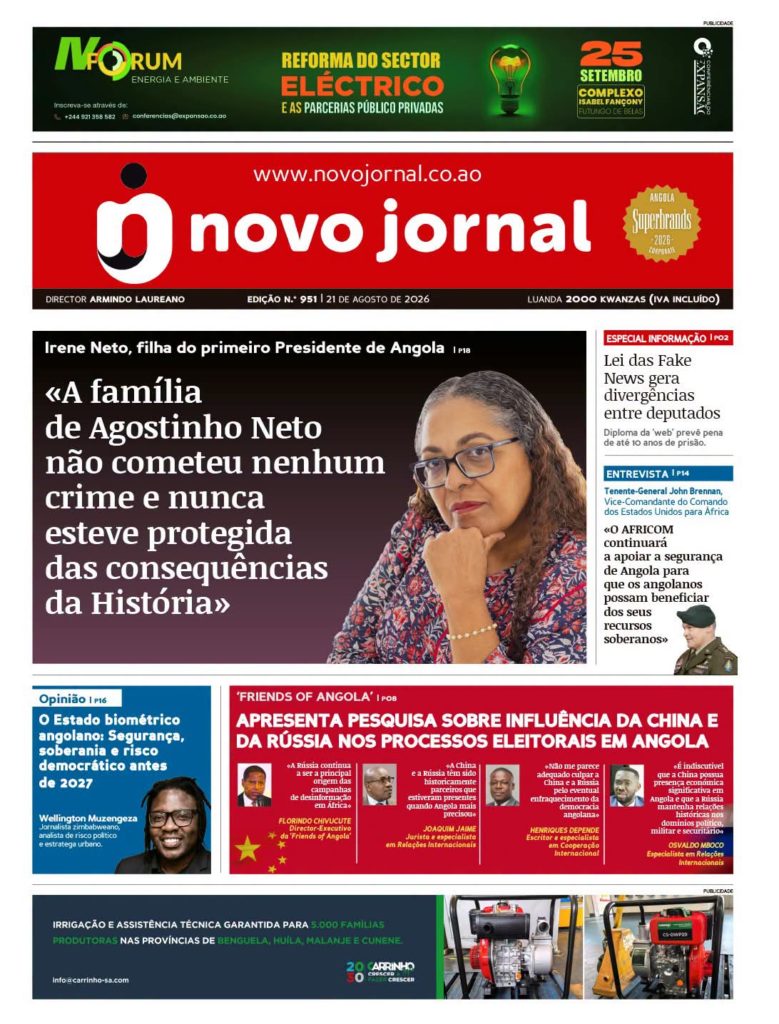
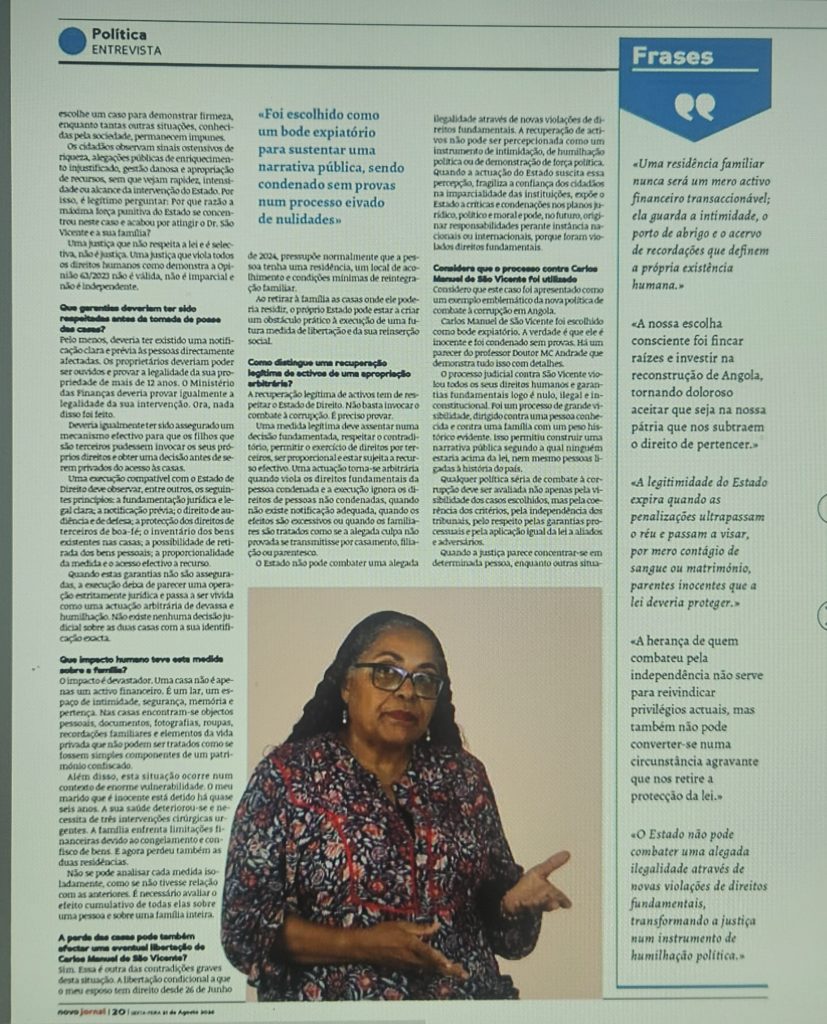
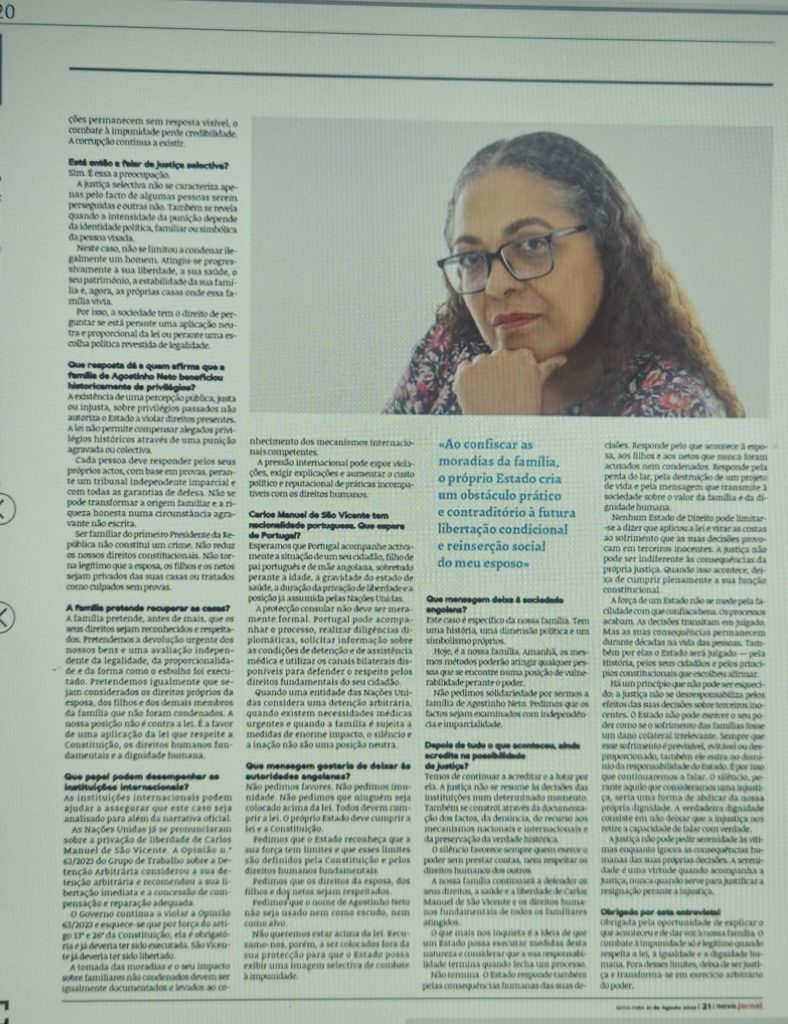
THEY ARE DESTROYING THE ROOTS WE PUT DOWN IN OUR OWN COUNTRY – IRENE NETO, daughter of Angola’s first President – NOVO JORNAL No. 951
The expropriation and dispossession of two homes in Luanda belonging to the children of Carlos Manuel de São Vicente are described by the family as a human tragedy with devastating consequences and a form of “collective punishment”. In an interview with Novo Jornal, Irene Neto — former Secretary of State for Cooperation at the Ministry of Foreign Affairs, former member of the National Assembly, a position she relinquished in 2017, and daughter of Angola’s first President, Dr António Agostinho Neto — breaks her silence to denounce the action taken by the authorities on 7 and 8 July. She says it was carried out without any prior notification or formal accusation against the occupants. While the defence challenges the legality of the measure, arguing that enforcement of a judgment against the businessman cannot violate the rights of third-party family members, the case has reignited public debate over the State’s conduct in asset recovery. This new dimension of a case in which the United Nations has already issued an opinion concerning São Vicente’s detention places the official narrative of equality before the law against allegations of political persecution and the dismantling of a family’s historical legacy.
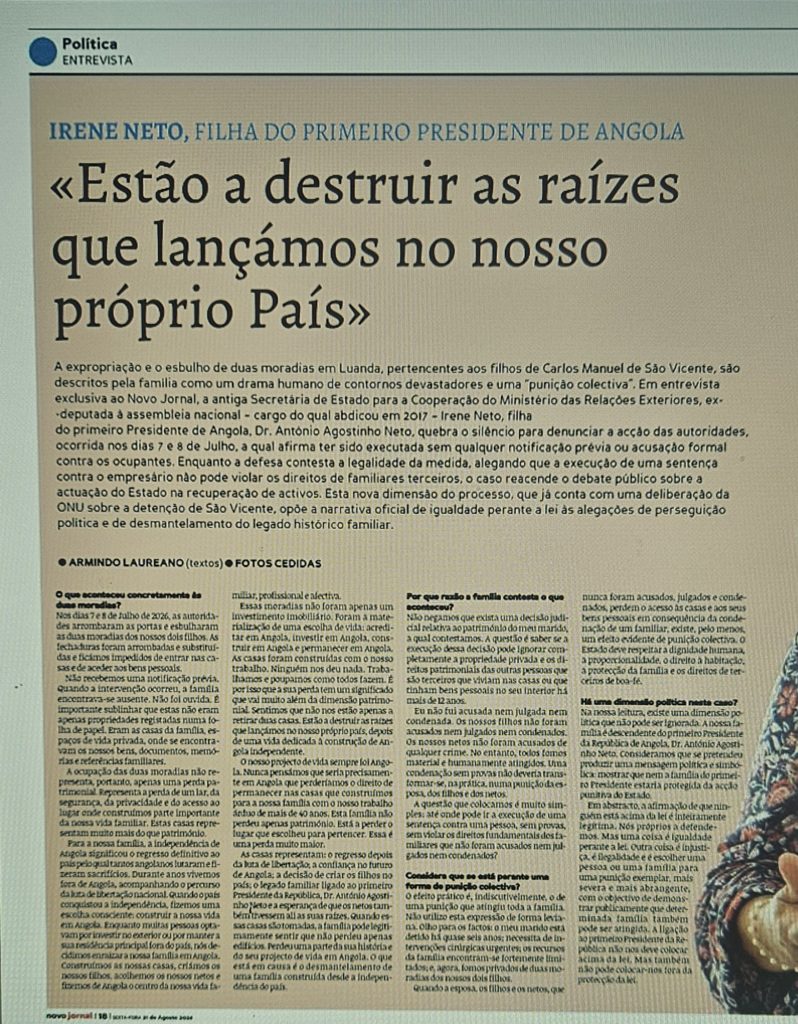
IRENE NETO, daughter of Angola’s first President
“THEY ARE DESTROYING THE ROOTS WE PUT DOWN IN OUR OWN COUNTRY”
What exactly happened to the two homes?
On 7 and 8 July 2026, the authorities forced open the doors and took possession of the two homes belonging to our two children. The locks were broken and replaced, and we were prevented from entering the houses and accessing our personal belongings.
We received no prior notification. When the intervention took place, the family was away. We were not heard. It is important to stress that these were not merely properties registered on a sheet of paper. They were our family homes, private living spaces containing our belongings, documents, memories and family references.
The taking of the two homes therefore represents much more than a financial loss. It represents the loss of a home, security, privacy and access to the place where we built an important part of our family life. These houses represent much more than property.
For our family, Angola’s independence meant the definitive return to the country for which so many Angolans had fought and made sacrifices. For years we lived outside Angola while following the course of the national liberation struggle. When the country achieved independence, we made a conscious choice: to build our lives in Angola. While many people chose to invest abroad or maintain their main residence outside the country, we decided to put down our family roots in Angola.
We built our homes, raised our children, welcomed our grandchildren and made Angola the centre of our family, professional and emotional life.
Those homes were not merely a real-estate investment. They embodied a life choice: to believe in Angola, invest in Angola, build in Angola and remain in Angola. The houses were built through our own work. Nobody gave us anything. We worked and saved, as everyone does. That is why their loss has a meaning that goes far beyond the financial dimension. We feel that they are not merely taking two houses from us. They are destroying the roots we put down in our own country after a lifetime devoted to building an independent Angola.
Our life project was always Angola. We never imagined that it would be precisely in Angola that we would lose the right to remain in the homes we built for our family through more than 40 years of hard work. This family has not merely lost property. It is losing the place it chose to belong. That is a much greater loss.
The houses represent our return after the liberation struggle; our confidence in Angola’s future; our decision to raise our children in the country; the family legacy connected to the first President of the Republic, Dr António Agostinho Neto; and our hope that our grandchildren would also have their roots there. When those houses are taken, the family can legitimately feel that it has lost more than buildings. It has lost part of its history and of its life project in Angola. What is at stake is the dismantling of a family built since the country’s independence.
Why does the family challenge what happened?
We do not deny that there is a judicial decision concerning my husband’s assets, which we contest. The question is whether enforcement of that decision can completely disregard the private property and patrimonial rights of other people — third parties who lived in the houses or had personal belongings inside them for more than 12 years.
I was not accused, tried or convicted. Our children were not accused, tried or convicted. Our grandchildren were not accused of any crime. Yet all of us have been materially and humanly affected. A conviction without evidence should not, in practice, become punishment of the wife, children and grandchildren.
The question we ask is very simple: how far can enforcement of a judgment against one person go, without evidence, before it violates the fundamental rights of family members who were neither accused, tried nor convicted?
Do you consider this a form of collective punishment?
The practical effect is unquestionably that of punishment affecting the entire family. I do not use that expression lightly. I look at the facts: my husband has been detained for almost six years; he requires urgent surgical procedures; the family’s resources are severely restricted; and now we have been deprived of the two homes belonging to our two children.
When the wife, children and grandchildren, who have never been accused, tried or convicted, lose access to their homes and personal belongings as a consequence of the conviction of a family member, there is, at the very least, an evident effect of collective punishment. The State must respect human dignity, proportionality, the right to housing, protection of the family and the rights of third parties acting in good faith.
Is there a political dimension to this case?
In our view, there is a political dimension that cannot be ignored. Our family descends from the first President of the Republic of Angola, Dr António Agostinho Neto. We believe that a political and symbolic message was intended: to show that not even the family of the first President would be protected from the punitive action of the State.
In the abstract, the assertion that nobody is above the law is entirely legitimate. We ourselves defend it. But equality before the law is one thing. Injustice and illegality — selecting a person or a family for exemplary punishment that is more severe and more extensive, in order to demonstrate publicly that a particular family can also be targeted — are something else. Our connection to the first President of the Republic must not place us above the law. But neither can it place us outside the protection of the law.
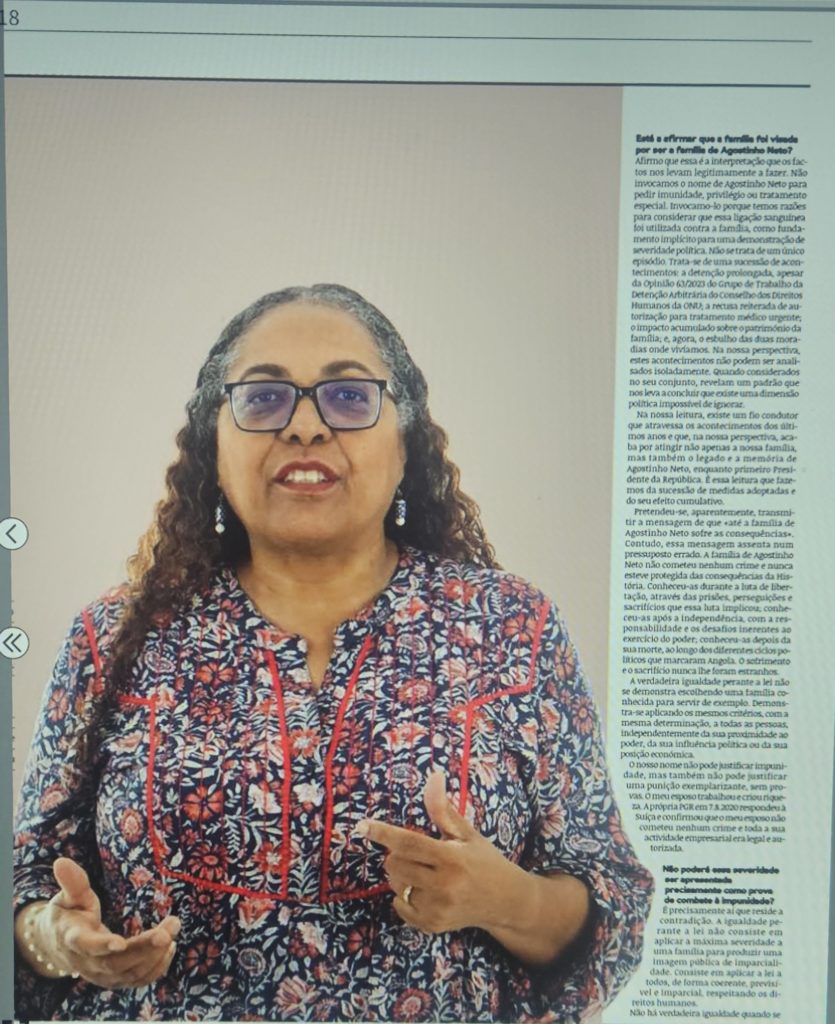
Are you saying that the family was targeted because it is Agostinho Neto’s family?
I am saying that this is the interpretation to which the facts legitimately lead us. We do not invoke Agostinho Neto’s name to seek immunity, privilege or special treatment. We invoke it because we have reason to believe that this blood relationship was used against the family as an implicit basis for a demonstration of political severity.
This is not a single episode. It is a succession of events: prolonged detention despite Opinion No. 63/2023 of the United Nations Working Group on Arbitrary Detention; repeated refusals to authorise urgent medical treatment; the cumulative impact on the family’s assets; and now the dispossession of the two homes in which we lived. In our view, these events cannot be analysed in isolation. Taken together, they reveal a pattern that leads us to conclude that there is a political dimension that is impossible to ignore.
In our view, there is a common thread running through the events of recent years which ultimately affects not only our family but also the legacy and memory of Agostinho Neto as the first President of the Republic. That is our interpretation of the succession of measures adopted and their cumulative effect.
Apparently, the intended message was that “even Agostinho Neto’s family suffers the consequences”. But that message rests on a false premise. Agostinho Neto’s family committed no crime and has never been shielded from the consequences of history. It experienced them during the liberation struggle, through the imprisonment, persecution and sacrifices that struggle entailed; it experienced them after independence, with the responsibility and challenges inherent in exercising power; and it experienced them after his death, through the different political cycles that have marked Angola. Suffering and sacrifice have never been foreign to this family.
True equality before the law is not demonstrated by choosing a well-known family to serve as an example. It is demonstrated by applying the same criteria, with the same determination, to everyone, regardless of proximity to power, political influence or economic position.
Our name cannot justify impunity, but neither can it justify exemplary punishment without evidence. My husband worked and created wealth. On 7 August 2020, the Office of the
Attorney General itself replied to Switzerland and confirmed that my husband had committed no crime and that all his business activity was lawful and authorised.
Could this severity not be presented precisely as evidence of the fight against impunity?
That is precisely where the contradiction lies. Equality before the law does not mean applying maximum severity to one family in order to create a public image of impartiality. It means applying the law to everyone coherently, predictably and impartially, while respecting human rights.
There is no genuine equality when one case is selected to demonstrate firmness while so many other situations known to society remain unpunished. Citizens see ostentatious signs of wealth, public allegations of unjustified enrichment, harmful management and appropriation of resources without seeing the same speed, intensity or scope of State intervention. It is therefore legitimate to ask: why was the maximum punitive force of the State concentrated on this case, ultimately affecting Dr São Vicente and his family?
Justice that does not respect the law and is selective is not justice. Justice that violates all human rights, as demonstrated by Opinion No. 63/2023, is neither valid, impartial nor independent.
What safeguards should have been respected before possession of the houses was taken?
At the very least, there should have been clear prior notification to the people directly affected. The owners should have been heard and given the opportunity to prove the lawfulness of their ownership of more than 12 years. The Ministry of Finance should likewise have demonstrated the legal basis for its intervention. None of this was done.
There should also have been an effective mechanism enabling the children, as third parties, to assert their own rights and obtain a decision before being deprived of access to their homes.
Enforcement compatible with the rule of law must observe, among others, the following principles: a clear legal basis and reasoning; prior notification; the right to be heard and to defend oneself; protection of the rights of third parties acting in good faith; an inventory of the belongings inside the houses; the opportunity to remove personal belongings; proportionality of the measure; and effective access to a remedy.
When these safeguards are not ensured, enforcement ceases to appear as a strictly legal operation and is experienced instead as an arbitrary act of intrusion and humiliation. There is no judicial decision specifically identifying these two houses.
What human impact has this measure had on the family?
The impact is devastating. A house is not merely a financial asset. It is a home, a place of intimacy, security, memory and belonging. The houses contain personal objects, documents,
photographs, clothing, family mementos and elements of private life that cannot be treated as though they were merely components of confiscated property.
Moreover, this situation is occurring in a context of extreme vulnerability. My husband, who is innocent, has been detained for almost six years. His health has deteriorated and he requires three urgent surgical procedures. The family faces financial constraints as a result of the freezing and confiscation of assets. And now it has also lost the two residences.
Each measure cannot be analysed in isolation, as though it bore no relation to the measures that preceded it. The cumulative effect of all of them on one person and on an entire family must be assessed.
Could the loss of the homes also affect the possible release of Carlos Manuel de São Vicente?
Yes. That is another serious contradiction in this situation. The conditional release to which my husband has been entitled since 26 June 2024 normally presupposes that the person has a residence, a place where he can be received and minimum conditions for family reintegration.
By taking away the homes where he could live, the State itself may be creating a practical obstacle to the implementation of a future release measure and to his social reintegration.
How do you distinguish legitimate asset recovery from arbitrary appropriation?
Legitimate asset recovery must respect the rule of law. It is not enough to invoke the fight against corruption. Evidence is required.
A legitimate measure must be based on a reasoned decision, respect adversarial proceedings, allow third parties to exercise their rights, be proportionate and be subject to an effective remedy. State action becomes arbitrary when it violates the fundamental rights of the convicted person and enforcement disregards the rights of people who have not been convicted; when there is no adequate notification; when the effects are excessive; or when relatives are treated as though alleged, unproven guilt could be transmitted through marriage, descent or kinship.
The State cannot fight an alleged illegality by committing new violations of fundamental rights. Asset recovery cannot be perceived as an instrument of intimidation, political humiliation or a demonstration of political force.
When State action gives rise to such a perception, it weakens citizens’ confidence in the impartiality of institutions, exposes the State to criticism and condemnation at the legal, political and moral levels, and may in future give rise to responsibility before national or international bodies because fundamental rights have been violated.
Do you believe that the proceedings against Carlos Manuel de São Vicente were used to construct a political narrative around the fight against corruption?
I believe that this case was presented as an emblematic example of Angola’s new anti-corruption policy.
Carlos Manuel de São Vicente was chosen as a scapegoat. The truth is that he is innocent and was convicted without evidence. There is a legal opinion by Professor Dr M. C. Andrade that demonstrates all of this in detail.
The judicial proceedings against São Vicente violated all his human rights and fundamental guarantees and are therefore null, unlawful and unconstitutional. It was a highly visible case directed against a well-known person and a family with an evident historical significance. This made it possible to construct a public narrative that nobody was above the law, not even people connected to the country’s history.
Any serious anti-corruption policy must be assessed not only by the visibility of the cases selected, but also by the consistency of the criteria applied, the independence of the courts, respect for procedural safeguards and equal application of the law to allies and adversaries.
When justice appears to concentrate on a particular person while other situations remain without a visible response, the fight against impunity loses credibility. Corruption continues to exist.
So you are talking about selective justice?
Yes. That is the concern.
Selective justice is not characterised only by the fact that some people are prosecuted while others are not. It is also revealed when the intensity of punishment depends on the political, family or symbolic identity of the person targeted.
In this case, the authorities did not merely unlawfully convict one man. They progressively affected his liberty, his health, his property, the stability of his family and now the very homes in which that family lived.
Society therefore has the right to ask whether this is a neutral and proportionate application of the law or a political choice clothed in legality.
How do you respond to those who say that Agostinho Neto’s family historically benefited from privileges?
The existence of a public perception, whether fair or unfair, concerning past privileges does not authorise the State to violate present rights. The law does not permit alleged historical privileges to be offset through aggravated or collective punishment.
Each person must answer for his or her own acts, on the basis of evidence, before an independent and impartial court and with all guarantees of defence. Family origin and honestly acquired wealth cannot be transformed into an unwritten aggravating circumstance.
Being a relative of the first President of the Republic is not a crime. It does not diminish our constitutional rights. It does not make it lawful for the wife, children and grandchildren to be deprived of their homes or treated as guilty without evidence.
Does the family intend to recover the houses?
Above all, the family wants its rights to be recognised and respected. We seek the urgent return of our belongings and an independent assessment of the legality, proportionality and manner in which the dispossession was carried out.
We also want the individual rights of the wife, children and other family members who were not convicted to be taken into account. Our position is not against the law. It is in favour of an application of the law that respects the Constitution, fundamental human rights and human dignity.
What role can international institutions play?
International institutions can help ensure that this case is examined beyond the official narrative.
The United Nations has already expressed its position on the deprivation of liberty of Carlos Manuel de São Vicente. Opinion No. 63/2023 of the Working Group on Arbitrary Detention found his detention to be arbitrary and recommended his immediate release and the granting of appropriate compensation and reparation.
The Government continues to disregard Opinion No. 63/2023 and forgets that, by virtue of Articles 13 and 26 of the Constitution, it is binding and should already have been implemented. São Vicente should already have been released.
The taking of the homes and its impact on family members who have not been convicted should likewise be documented and brought to the attention of the competent international mechanisms.
International pressure can expose violations, demand explanations and increase the political and reputational cost of practices incompatible with human rights.
Carlos Manuel de São Vicente is a Portuguese national. What do you expect from Portugal?
We expect Portugal to actively follow the situation of one of its citizens, the son of a Portuguese father and an Angolan mother, particularly in view of his age, the seriousness of his health condition, the length of his deprivation of liberty and the position already taken by the United Nations.
Consular protection should not be merely formal. Portugal can follow the case, undertake diplomatic démarches, request information about detention conditions and medical care, and use the available bilateral channels to defend respect for the fundamental rights of its citizen.
When a United Nations body considers a detention arbitrary, when there are urgent medical needs and when the family is subjected to measures with an enormous impact, silence and inaction are not a neutral position.
What message would you like to leave with the Angolan authorities?
We are not asking for favours. We are not asking for immunity. We are not asking for anyone to be placed above the law. Everyone must comply with the law. The State itself must comply with the law and the Constitution.
We ask the State to recognise that its power has limits and that those limits are defined by the Constitution and fundamental human rights.
We ask that the rights of the wife, children and grandchildren be respected.
We ask that Agostinho Neto’s name be used neither as a shield nor as a target.
We do not want to be above the law. But we refuse to be placed outside its protection so that the State can display a selective image of the fight against impunity.
What message do you have for Angolan society?
This case is specific to our family. It has its own history, political dimension and symbolism.
Today it is our family. Tomorrow, the same methods may affect anyone who finds himself or herself in a position of vulnerability before those in power.
We do not ask for solidarity because we are Agostinho Neto’s family. We ask that the facts be examined independently and impartially.
After everything that has happened, do you still believe justice is possible?
We have to continue to believe in it and fight for it. Justice is not limited to the decisions of institutions at a particular moment. It is also built through documenting facts, speaking out, resorting to national and international mechanisms, and preserving historical truth.
Silence always favours those who exercise power without accountability and without respecting the human rights of others.
Our family will continue to defend its rights, the health and freedom of Carlos Manuel de São Vicente, and the fundamental human rights of all family members affected.
What concerns us most is the idea that a State can carry out measures of this nature and consider that its responsibility ends when it closes a case.
It does not. The State is also responsible for the human consequences of its decisions. It is responsible for what happens to the wife, children and grandchildren who were never accused or convicted. It is responsible for the loss of a home, the destruction of a life project and the message it sends to society about the value of family and human dignity.
No State governed by the rule of law can simply say that it applied the law and turn its back on the suffering its decisions cause to innocent third parties. Justice cannot be indifferent to the consequences of justice itself. When that happens, it ceases fully to perform its constitutional function.
The strength of a State is not measured by how easily it confiscates assets. Proceedings end. Judgments become final. But their consequences remain in people’s lives for decades.
The State will also be judged by those consequences — by history, by its citizens and by the constitutional principles it chose to uphold.
There is one principle that must not be forgotten: justice cannot disclaim responsibility for the effects of its decisions on innocent third parties. The State cannot exercise its power as though the suffering of families were irrelevant collateral damage. Whenever that suffering is foreseeable, avoidable or disproportionate, it too falls within the sphere of State responsibility.
That is why we will continue to speak. Silence in the face of what we consider an injustice would amount to relinquishing our own dignity. True dignity lies in refusing to allow injustice to take away our ability to speak the truth.
Justice cannot ask victims for serenity while ignoring the human consequences of its own decisions. Serenity is a virtue when it accompanies justice; never when it is used to justify resignation in the face of injustice.
Thank you for this interview.
Thank you for the opportunity to explain what happened and to give our family a voice. The fight against impunity is legitimate only when it respects the law, equality and human dignity. Beyond those limits, it ceases to be justice and becomes an arbitrary exercise of power.
ARMINDO LAUREANO
Read more
THEY ARE DESTROYING THE ROOTS WE PUT DOWN IN OUR OWN COUNTRY – IRENE NETO, daughter of Angola’s first President – NOVO JORNAL No. 951
The expropriation and dispossession of two homes in Luanda belonging to the children of Carlos Manuel de São Vicente are described by the family as a human tragedy with devastating consequences and a form of “collective punishment”. In an interview with Novo Jornal, Irene Neto — former Secretary of State for Cooperation at the Ministry […]
SCAPEGOAT HUNT – The Stigma of The Wealth of São Vicente
Irene Alexandra Neto – 16.11.2025 Because silence weighs heavily, injustice persists and the truth needs to be told. There are ancient phenomena that cross the centuries like persistent shadows. One is the human—almost biblical—need to find a scapegoat whenever a society goes into upheaval. Times change, instruments change, but the moral mechanics are the same […]